◉ Cambridge, MA
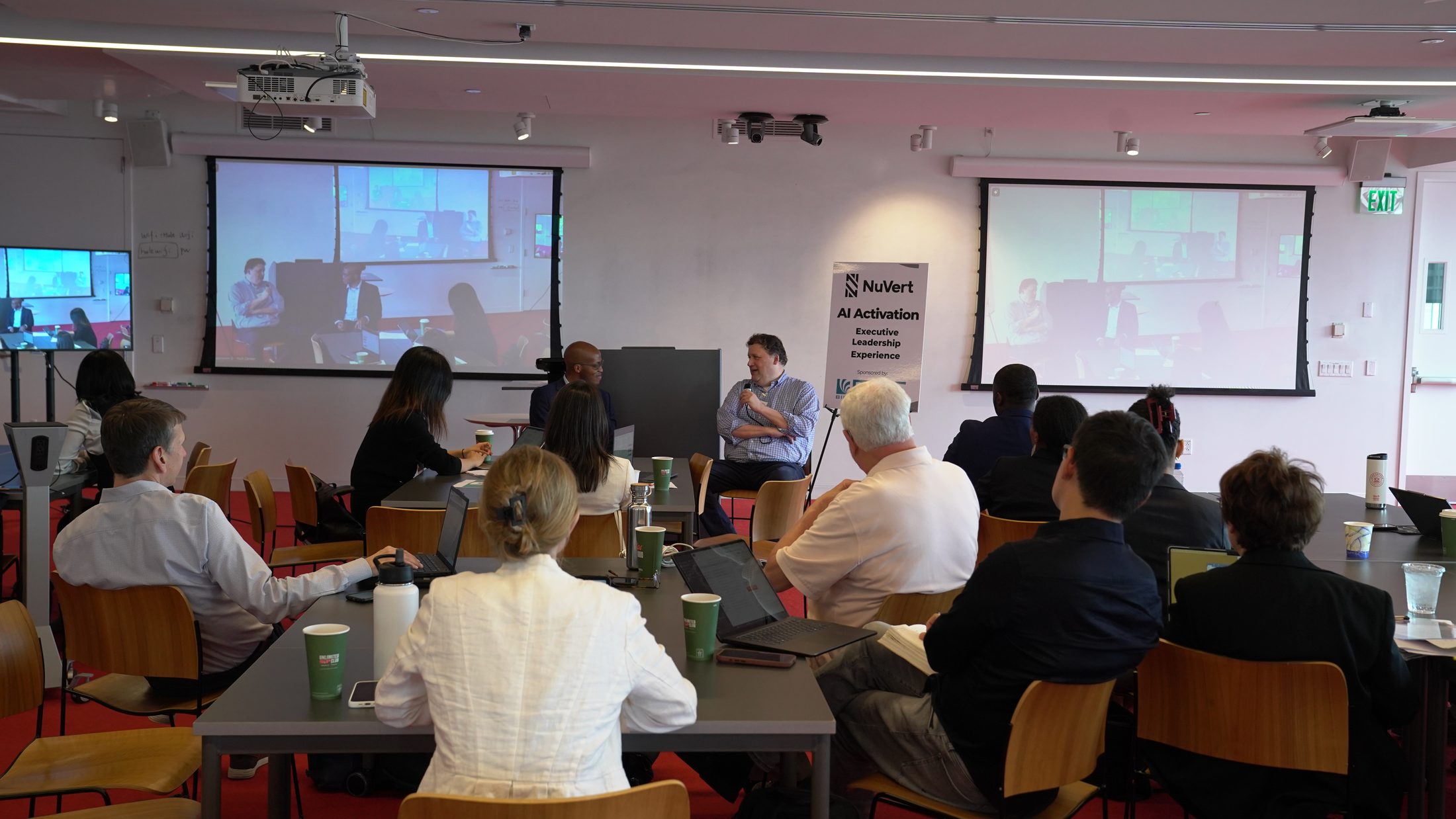
The NuVert AI Activation Summit convened senior leaders, investors, technologists, and practitioners for a three-day, deeply substantive experience focused on one core challenge: how organizations actually lead, govern, and scale AI responsibly in the real world.
Nadia delivered a compelling deep dive into an AI business strategy framework, unpacking 11 critical dimensions teams must consider when building or adopting AI—from AI maturity and model choices to data strategy, regulation, and value creation. The session came alive through real-world case studies from Maven AGI (customer support) and Descrybe AI (legal research), offering a clear roadmap for turning AI strategy into impact.
This wasn't your average lunch break. Over great food, participants engaged in a dynamic, hands-on discussion about responsible AI adoption, sharing challenges, lessons learned, and solutions across sectors. A truly collaborative exchange of ideas.
Stephen made a strong case for why proprietary data—not models—is the real differentiator in today's AI landscape. He explored the commoditization of AI models, falling compute costs, and practical strategies for nonprofits to build and scale AI capabilities for long-term advantage.
Mark closed the day by zooming out to the big picture: the shift toward multimodal AI. He highlighted the importance of integrating multiple data modalities, adopting pragmatic AI strategies, and prioritizing security and compliance in this next wave of AI transformation.
Laurence unpacked the "AI paradox" leaders are feeling in real time: faster output doesn't automatically equal better outcomes. He focused on what to measure (and what not to confuse for progress), giving participants practical ways to define baselines, track lift vs. risk, and evaluate AI initiatives with the same rigor they'd apply to any core business investment.
Rich delivered an operator's guide to making AI real inside complex organizations - where models shift after deployment, regulations evolve, and boards demand decisions you can defend. Through a transformation case study, she emphasized that AI strategy is now a living strategy: probabilistic, enterprise-wide, and shared across legal, finance, security, HR, and technology. Key takeaways included defining clear human vs. machine decision boundaries, balancing centralized governance with federated innovation, and building auditability and observability into platforms so compliance and performance improve as systems scale.
An interactive block where participants rotated through partner-led stations to explore tools, implementation patterns, and real use cases up close. Station 1 featured AIDEA (Geraldine Garcia Medina) and Ielumen (Bich-Thuy Le); Station 2 featured GoldStar (Thomas Baker) and TNT (Rob Blaine); Station 3 featured PhiLabs (Eduardo Baena).
Aleksandra Przegalińska examined why AI's real productivity gains often fall short of expectations, despite rapid advances in capability. Drawing on long-term research in human-AI interaction, she emphasized collaborative use over delegation, highlighting how trust, onboarding, and governance shape outcomes. Her session reframed regulation as an enabler of responsible experimentation—arguing that clear guardrails are essential for scaling AI without eroding human judgment or expertise.
George Westerman addressed why most AI initiatives stall at the pilot stage and what it takes to achieve durable, enterprise-wide impact. He showed how successful organizations move beyond experimentation by pairing strong governance with clear ownership, change management, and measurable outcomes. The session focused on turning AI into a repeatable capability - one that augments work, improves quality, and delivers sustained value at scale.
Want to be part of the next NuVert AI Activation Summit? Reach out and we'll bring clarity and coherence to your AI journey.
Request consultation ↗